Inspired by local industry

SIM is the city’s signage and orientation information system. It is part of the city’s infrastructure, and affects the ergonomics and convenience of the city, as well as its aesthetics and image.

Inspired by local industry

SIM is the city’s signage and orientation information system. It is part of the city’s infrastructure, and affects the ergonomics and convenience of the city, as well as its aesthetics and image.

Inspired by local industry

SIM is the city’s signage and orientation information system. It is part of the city’s infrastructure, and affects the ergonomics and convenience of the city, as well as its aesthetics and image.

A “Plac Wolności” sign and black fingerposts to “Dworzec kolejowy” and “Strefa Juliusza” on a pole, with a facade and blue sky.

City Information System:

Analysis, conclusions

Inventory

Documentation and analysis of current solutions

Functional concept

Design concept

Concept of rules for placement of attachment, foundation

Graphic concept

Graphic elements

Illustrations

Icons and infographics

Implementation

Design

Placement / foundation rules

A “Plac Wolności” sign and black fingerposts to “Dworzec kolejowy” and “Strefa Juliusza” on a pole, with a facade and blue sky.

City Information System:

Analysis, conclusions

+

Functional concept

+

Graphic concept

+

Implementation

+

A “Plac Wolności” sign and black fingerposts to “Dworzec kolejowy” and “Strefa Juliusza” on a pole, with a facade and blue sky.

City Information System:

Analysis, conclusions

Inventory

Documentation and analysis of current solutions

Functional concept

Design concept

Concept of rules for placement of attachment, foundation

Graphic concept

Graphic elements

Illustrations

Icons and infographics

Implementation

Design

Placement / foundation rules

Red Dot award logo: a red and white diagonally striped sphere above the words “reddot winner 2024”.
“Śląska Rzecz” logo: a black diamond topped with a red triangle and an ® mark, with the name below.
“Dobry Wzór” logo: the name in a white rounded frame set over vertical red stripes.
KTR mark: tall, narrow letters K, T and R set inside a dark upright rectangle like a maze.
Red Dot award logo: a red and white diagonally striped sphere above the words “reddot winner 2024”.
“Śląska Rzecz” logo: a black diamond topped with a red triangle and an ® mark, with the name below.
“Dobry Wzór” logo: the name in a white rounded frame set over vertical red stripes.
KTR mark: tall, narrow letters K, T and R set inside a dark upright rectangle like a maze.
Red Dot award logo: a red and white diagonally striped sphere above the words “reddot winner 2024”.
“Śląska Rzecz” logo: a black diamond topped with a red triangle and an ® mark, with the name below.
“Dobry Wzór” logo: the name in a white rounded frame set over vertical red stripes.
KTR mark: tall, narrow letters K, T and R set inside a dark upright rectangle like a maze.

Rybnik is spatially diverse. The historic buildings of the Market Square, which is the meeting point of all transportation routes, are adjacent to the newer architecture of the city center. 

Traditional, sometimes historic buildings are adjacent to housing estates, low-rise buildings and new residential, office, industrial and warehouse buildings.

Rybnik is spatially diverse. The historic buildings of the Market Square, which is the meeting point of all transportation routes, are adjacent to the newer architecture of the city center. 

Traditional, sometimes historic buildings are adjacent to housing estates, low-rise buildings and new residential, office, industrial and warehouse buildings.

Rybnik is spatially diverse. The historic buildings of the Market Square, which is the meeting point of all transportation routes, are adjacent to the newer architecture of the city center. 

Traditional, sometimes historic buildings are adjacent to housing estates, low-rise buildings and new residential, office, industrial and warehouse buildings.

Aerial view of a red-brick neo-Gothic church with two green spires surrounded by city blocks and trees.

Elements of the City Information System include municipal address signs for buildings and properties, street name boards, public buildings, signposts, maps, signs and information at public transportation stops, parking lots or parks.

Elements of the City Information System include municipal address signs for buildings and properties, street name boards, public buildings, signposts, maps, signs and information at public transportation stops, parking lots or parks.

Elements of the City Information System include municipal address signs for buildings and properties, street name boards, public buildings, signposts, maps, signs and information at public transportation stops, parking lots or parks.

Diagram of 16 system elements, from address and street signs to fingerposts, maps and shelters, with a human figure for scale.
  1. Tablice adresowe – naścienne;

  2. Oznaczenia adresowe malowane na elewacjach;

  3. Tablice ulicowe – naścienne;

  4. Tablice pamiątkowe, informacje o zabytkach;

  5. Tablice ulicowe i drogowskazowe wolnostojące;

  6. Tablice ulicowe i drogowskazowe na słupach;

  7. Tablice na skwerach, rondach i w parkach;

  8. Oznaczenia terenów rekreacyjnych;

  9. Oznaczenie stacji rowerów miejskich;

  10. Oznaczenia parkingów miejskich;

  11. Oznaczenia obiektów użyteczności publicznej;

  12. Informacje komercyjne – naścienne;

  13. Informacje komercyjne – dojazdowe;

  14. Przystanki – wiaty i słupki;

  15. Mapy miejskie;

  16. Witacze przy wjazdach do miasta.

Diagram of 16 system elements, from address and street signs to fingerposts, maps and shelters, with a human figure for scale.
  1. Tablice adresowe – naścienne;

  2. Oznaczenia adresowe malowane na elewacjach;

  3. Tablice ulicowe – naścienne;

  4. Tablice pamiątkowe, informacje o zabytkach;

  5. Tablice ulicowe i drogowskazowe wolnostojące;

  6. Tablice ulicowe i drogowskazowe na słupach;

  7. Tablice na skwerach, rondach i w parkach;

  8. Oznaczenia terenów rekreacyjnych;

  9. Oznaczenie stacji rowerów miejskich;

  10. Oznaczenia parkingów miejskich;

  11. Oznaczenia obiektów użyteczności publicznej;

  12. Informacje komercyjne – naścienne;

  13. Informacje komercyjne – dojazdowe;

  14. Przystanki – wiaty i słupki;

  15. Mapy miejskie;

  16. Witacze przy wjazdach do miasta.

Diagram of 16 system elements, from address and street signs to fingerposts, maps and shelters, with a human figure for scale.
  1. Tablice adresowe – naścienne;

  2. Oznaczenia adresowe malowane na elewacjach;

  3. Tablice ulicowe – naścienne;

  4. Tablice pamiątkowe, informacje o zabytkach;

  5. Tablice ulicowe i drogowskazowe wolnostojące;

  6. Tablice ulicowe i drogowskazowe na słupach;

  7. Tablice na skwerach, rondach i w parkach;

  8. Oznaczenia terenów rekreacyjnych;

  9. Oznaczenie stacji rowerów miejskich;

  10. Oznaczenia parkingów miejskich;

  11. Oznaczenia obiektów użyteczności publicznej;

  12. Informacje komercyjne – naścienne;

  13. Informacje komercyjne – dojazdowe;

  14. Przystanki – wiaty i słupki;

  15. Mapy miejskie;

  16. Witacze przy wjazdach do miasta.

Directional signs, or sign boards (distributing traffic) complement street signs on poles. They are double-sided, and can contain 2 (150 mm board height) or 3 (210 mm board height) lines of information. The boards contain: a directional arrow, the name of the place and the distance in kilometers, and – only for city parking lots and urban bicycle stations – additional icons with reduced signs.

Directional signs, or sign boards (distributing traffic) complement street signs on poles. They are double-sided, and can contain 2 (150 mm board height) or 3 (210 mm board height) lines of information. The boards contain: a directional arrow, the name of the place and the distance in kilometers, and – only for city parking lots and urban bicycle stations – additional icons with reduced signs.

Directional signs, or sign boards (distributing traffic) complement street signs on poles. They are double-sided, and can contain 2 (150 mm board height) or 3 (210 mm board height) lines of information. The boards contain: a directional arrow, the name of the place and the distance in kilometers, and – only for city parking lots and urban bicycle stations – additional icons with reduced signs.

Renderings of a single pole with a “Janke-Waltera” street sign and a two-part pole with a “Kościuszki” sign and black fingerpost.
Exploded axonometric view of signs – house number “1”, street “3 Maja” and a pale blue “Muzeum” plaque – on black brackets.
Renderings of a single pole with a “Janke-Waltera” street sign and a two-part pole with a “Kościuszki” sign and black fingerpost.
Exploded axonometric view of signs – house number “1”, street “3 Maja” and a pale blue “Muzeum” plaque – on black brackets.
Renderings of a single pole with a “Janke-Waltera” street sign and a two-part pole with a “Kościuszki” sign and black fingerpost.
Exploded axonometric view of signs – house number “1”, street “3 Maja” and a pale blue “Muzeum” plaque – on black brackets.
  • Technical drawing of address plates in three sizes, numbered “1”, “12A”, “12B” and “128”, with Favela type settings.
  • Technical drawing of street name signs in three lengths – “Sygnały”, “Nad Nacyną” and “Powstańców Śląskich” – with dimensions.
  • Black two- and three-line fingerposts, front and back, with arrows, distances and the destination “Bazylika Św. Antoniego”.
  • Red official plaques in three sizes, including “Rada i Prezydent Miasta Rybnika” and “Urząd Miasta Rybnika”, with dimensions.
  • White directional board with arrows to “Drewmax Plus” and “Elektrownia Rybnik” and a black strip at the bottom, with dimensions.
  • Drawing of bus stop signage: blue signs with a bus symbol, a “Stanowisko 2” post, a departures display and a woman’s silhouette.

The color scheme of the elements of the City Information System in Rybnik refers to the city’s Visual Identification System and includes white, black and light blue, supplemented by red – the prescribed color of official and school boards.

The color scheme of the elements of the City Information System in Rybnik refers to the city’s Visual Identification System and includes white, black and light blue, supplemented by red – the prescribed color of official and school boards.
The color scheme of the elements of the City Information System in Rybnik refers to the city’s Visual Identification System and includes white, black and light blue, supplemented by red – the prescribed color of official and school boards.

System palette in four fields – red, pale blue, black and white – each with its use and RAL, Pantone, CMYK and RGB values.
Type specimen of Favela Regular, Medium, Light and Semibold with sample sign texts and a set of direction arrows.
System palette in four fields – red, pale blue, black and white – each with its use and RAL, Pantone, CMYK and RGB values.
Type specimen of Favela Regular, Medium, Light and Semibold with sample sign texts and a set of direction arrows.
System palette in four fields – red, pale blue, black and white – each with its use and RAL, Pantone, CMYK and RGB values.
Type specimen of Favela Regular, Medium, Light and Semibold with sample sign texts and a set of direction arrows.
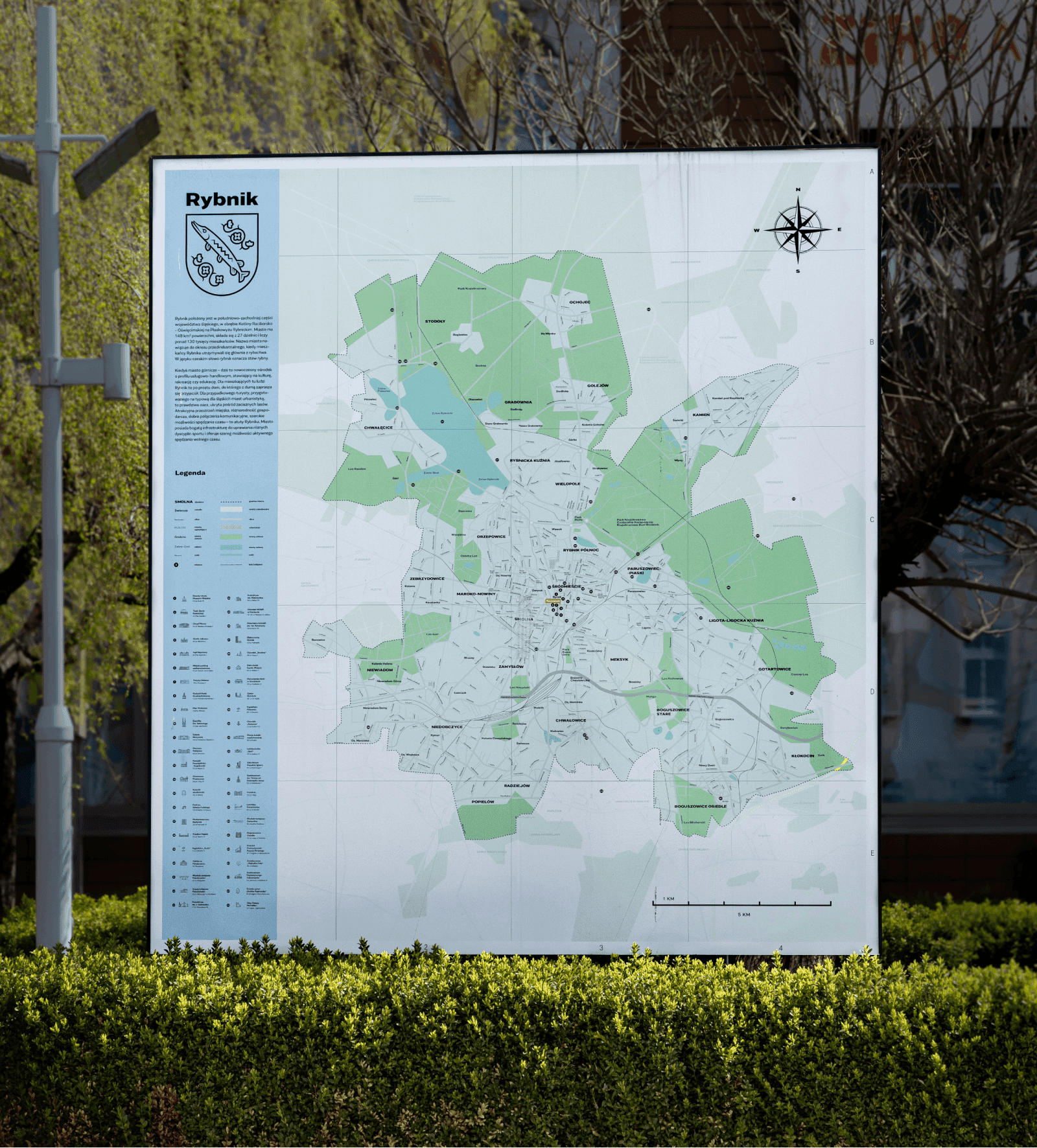
A large city map board headed “Rybnik”, with a crest and legend, standing behind a hedge next to a street lamp.
36 line pictograms of city landmarks with captions such as “Zalew Rybnicki”, “Elektrownia Rybnik” and “Familoki”, on pale blue.
A large city map board headed “Rybnik”, with a crest and legend, standing behind a hedge next to a street lamp.
36 line pictograms of city landmarks with captions such as “Zalew Rybnicki”, “Elektrownia Rybnik” and “Familoki”, on pale blue.
A large city map board headed “Rybnik”, with a crest and legend, standing behind a hedge next to a street lamp.
36 line pictograms of city landmarks with captions such as “Zalew Rybnicki”, “Elektrownia Rybnik” and “Familoki”, on pale blue.

The inspiration for the city plaques came from traditional street signs made of enameled sheet metal. The enameled products were the flagship product of Huta Silesia, no longer in existence but still important to the industrial history of Rybnik.

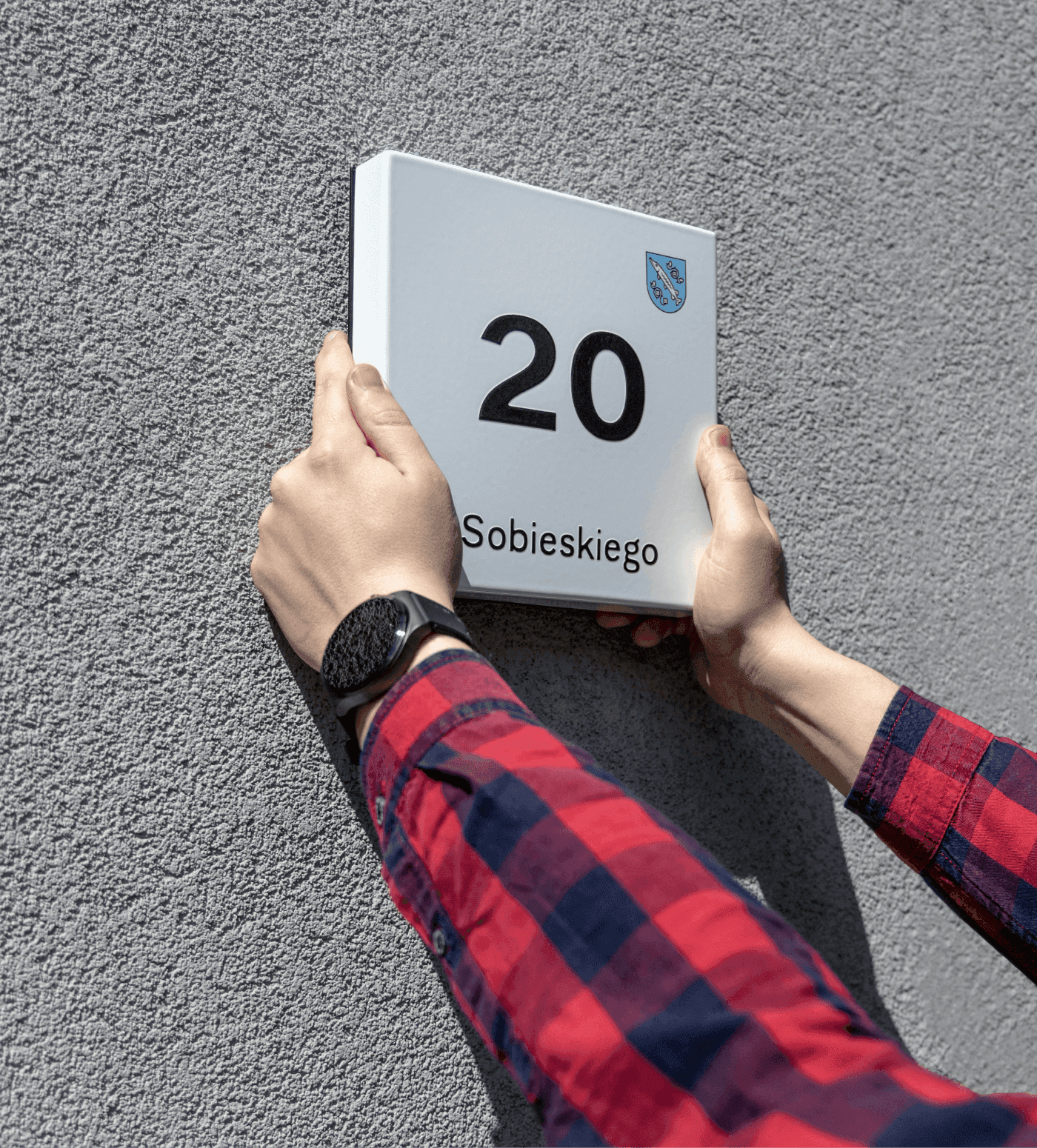
The inspiration for the city plaques came from traditional street signs made of enameled sheet metal. The enameled products were the flagship product of Huta Silesia, no longer in existence but still important to the industrial history of Rybnik.

The inspiration for the city plaques came from traditional street signs made of enameled sheet metal. The enameled products were the flagship product of Huta Silesia, no longer in existence but still important to the industrial history of Rybnik.

Hands in a red and navy checked shirt hold a white “20 Sobieskiego” house number plate with a crest against a grey wall.
Three workers in orange hi-vis clothing fit fingerposts to a pole beneath a “Plac Wolności” street sign.
Hands in a red and navy checked shirt hold a white “20 Sobieskiego” house number plate with a crest against a grey wall.
Three workers in orange hi-vis clothing fit fingerposts to a pole beneath a “Plac Wolności” street sign.
Hands in a red and navy checked shirt hold a white “20 Sobieskiego” house number plate with a crest against a grey wall.
Three workers in orange hi-vis clothing fit fingerposts to a pole beneath a “Plac Wolności” street sign.
A woman in a face mask walks past the corner of a grey building bearing the street signs “Bolesława Chrobrego” and “Miejska”.
A white “20 Sobieskiego” house number plate with black numerals and a blue crest on an orange brick wall.
A woman in a face mask walks past the corner of a grey building bearing the street signs “Bolesława Chrobrego” and “Miejska”.
A white “20 Sobieskiego” house number plate with black numerals and a blue crest on an orange brick wall.
A woman in a face mask walks past the corner of a grey building bearing the street signs “Bolesława Chrobrego” and “Miejska”.
A white “20 Sobieskiego” house number plate with black numerals and a blue crest on an orange brick wall.
  • The “Plac Wolności” sign and a black fingerpost to “Dworzec kolejowy” and “Strefa Juliusza” seen through budding branches.
  • A small “20 Sobieskiego” plate above a tall arched wooden door with glazed panels in a beige facade.
  • A pole with a “Kościuszki” street sign and black fingerposts as a motion-blurred white and blue bus passes behind.
  • Three “20 Sobieskiego” house number plates in different sizes lined up against greenery and flowering shrubs.
  • Close-up of hands pressing a white “20 Sobieskiego” plate with a blue crest against a textured wall.
  • Sample signs on a yellow display: “20 Sobieskiego”, “Korfantego”, “Przedszkole Nr 37” and a red “Urząd Stanu Cywilnego w Rybniku”.
  • A white “Plac Teatralny im. Kazimierza Kutza” street sign with a crest on a pole against blue sky and bare branches.
  • A red “Urząd Miasta Rybnika” plaque on a granite wall, with another red plaque further along the arcade.
  • An oval plaque with a blue crest featuring a fish and a pale blue “Żłobek Wesoła Rybka” sign on a grey facade beside trees.
  • Angled close-up of a white “20 Sobieskiego” plate with black lettering against a brick wall.
A pole with a “Kościuszki” street sign and black fingerposts to “Dworzec kolejowy” and “Stadion”, against a tree and sky.

2021-2024

Design team:

Marcin Wolny, Paulina Duźniak, Julek Wierzchowski

The team from the side of the Rybnik City Hall:

Robert Cebula, Kamil Styga

Zdjęcia i wideo:

Dominika Kufieta

2021-2024

Design team:

Marcin Wolny, Paulina Duźniak, Julek Wierzchowski

The team from the side of the Rybnik City Hall:

Robert Cebula, Kamil Styga

Zdjęcia i wideo:

Dominika Kufieta

2021-2024

Design team:

Marcin Wolny, Paulina Duźniak, Julek Wierzchowski

The team from the side of the Rybnik City Hall:

Robert Cebula, Kamil Styga

Zdjęcia i wideo:

Dominika Kufieta

Mimiś from Studio Otwarte — portrait of a man in glasses and a black T-shirt, seated in an armchair by a window

© 2026 × studio otwarte

Mimiś from Studio Otwarte — portrait of a man in glasses and a black T-shirt, seated in an armchair by a window

© 2026 × studio otwarte

Mimiś from Studio Otwarte — portrait of a man in glasses and a black T-shirt, seated in an armchair by a window

© 2026 × studio otwarte